
Baguazhang (translated as "The palm of the eight trigrams) is one of the most important internal martial arts from China. It was created in the early 19th century by Dong Haichuan and is based on the ancient Chinese concept of eight trigrams and an ancient form of Tibetan circular walking meditation.
The movements of Baguazhang are characterized by circular steps and the fighting is done by using palm strikes and kicks (never punches). The style was especially designed for fighting with several opponents at once and was most suitable for bodyguards.
After 1870 Baguazhang became so famous because of its fighting efficiency that all the personal bodyguards of the Chinese emperor had to be Baguazhang masters.
In our times, most people practise this art mainly for health benefits, although lately its fighting side has been emerging again.
Sun Zhijun is one of the most famous Baguazhang (Cheng style) masters of our times. Although he is over 70 in the clip, the video shows the movements of a young man with amazing physical and technical skills, beyond the abilities of most of the young people. Apparently, old age is more a state of mind than a real biological process!
Another impressive demonstration, by Lu Zijian (age 93 in the clip, now he is 115 and still alive) can be seen here.
Wednesday, May 28, 2008
Closer to eternal youth and immortality - Baguazhang

Sunday, May 25, 2008
Taijiquan and the empty mind
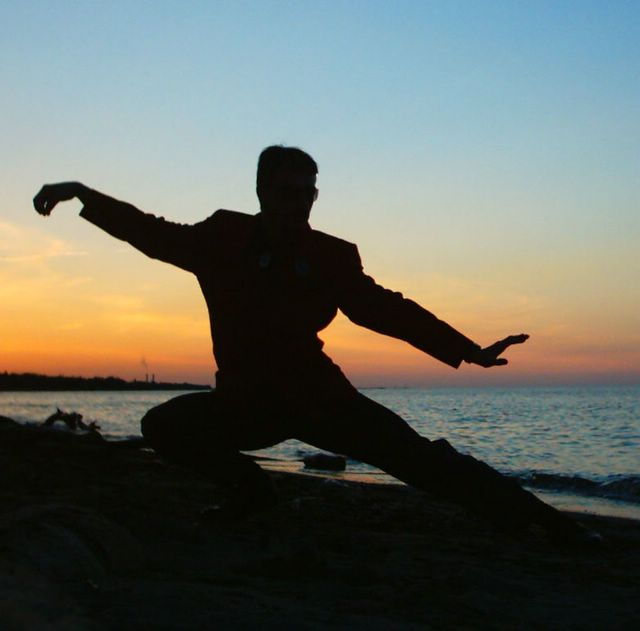 Taijiquan (traditional Chinese: 太極拳; simplified Chinese: 太极拳; pinyin: tàijíquán; Wade-Giles: t'ai4 chi2 ch'üan2) is, together with Liuhebafa, Xingyiquan, Baguazhang, Yiquan, Taikiken, Aikido and many others, an internal martial art.
The daoist master Zhang Sanfeng is credited as the creator of Taijiquan in the 13th century and the famous Five Dragon Temple from Wudang Mountains was the first place where the style became a daily routine for the daoist monks.
The Mandarin term "taijiquan" literally translates as "supreme ultimate fist", "boundless fist," or "great extremes boxing" and comes from the daoist philosophy.
Although the style used to be one of the most impressive and effective combat martial arts, Taijiquan is typically practised today mainly for health and longevity. Unfortunately, even in this aspect, the exercise that became very popular in the West and is called by most of the people "Tai Chi" is a very watered down version of what the art used to be in the past, with low benefits for both health and self-defence compared with the original. The long traditional forms have been replaced by shorter, "modern" forms which barely resemble the original movements. The people in the West, who want to learn a form in a few days, are also guilty for this situation. To learn the movements of a traditional form would take between 2-6 months and after that another 2-3 years for a decent execution, but the benefits for health and self-defence are worth the effort.
Although some people in the West, like Master Erle Montaigue have been working hard for many years to promote the original aspects of Taijiquan, most of the general public is not aware yet of the real effectiveness for health and especially self-defence of this art. As these two faces are interconnected, one cannot learn one without mastering the other. So, as a consequence, there cannot be such a thing as "Tai Chi for Health" without the fighting aspect.
With its long forms executed in slow motion, Taijiquan acts as a powerful moving meditation, circulating the qi energy through all the body channels during the practise. The mind empties and connects to the fundamental levels of the Universe with the body moving (at an advanced stage) only by the power of the thought. The practitioner feels invigorated and full of energy after finishing the set of movements.
At the Five Dragon Temple from Wudang Mountains, Taijiquan is still practised and taught today in the traditional manner (the students try to imitate the instructor practising the form until they master it). The video presents a typical class and a demonstration by one of the masters, the priest Yuen.


